
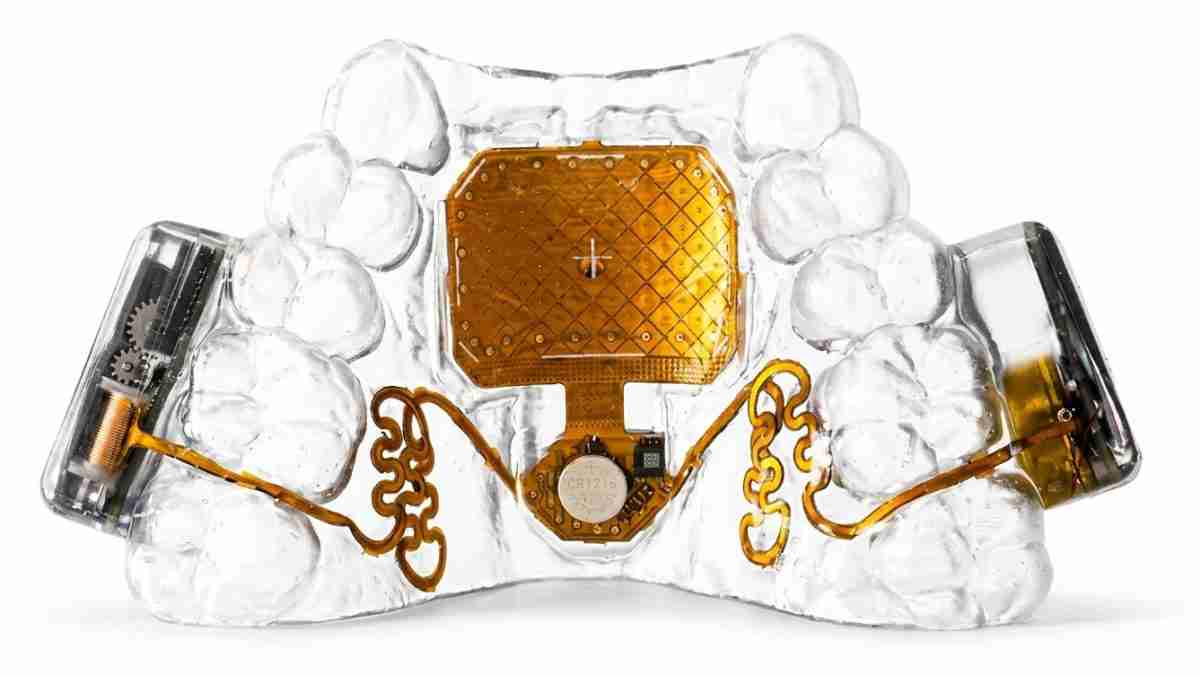
MADISON, Wis., Aug. 14 (Nationwide Times) — Augmental’s MouthPad is a custom-fit mouthpiece that lets users control a phone, tablet or computer with tongue and head movements. The device costs $1,400 for one unit and is currently sold and shipped only to U.S. addresses, according to Augmental.
The company opened public U.S. sales on July 22, 2026, after an Early Access program that began in 2024. Augmental says the device can be used outside the United States because it is not geo-restricted, but customers outside the U.S. cannot currently order it directly for shipment.
How the MouthPad works
MouthPad places a pressure-sensitive touchpad against the roof of the mouth. Sensors detect tongue movements and head motion, turning them into computer commands.
Augmental says the device can move a cursor, click, scroll, drag and swipe. A tongue press can be assigned to a left click or click-and-drag action. A sip gesture can serve as a right click. Head movements can also help guide the cursor.
The MouthPad connects over Bluetooth. Augmental lists compatibility with macOS, Windows, Linux, iOS and Android, allowing it to work with computers, phones and tablets that support the connection.
MIT News described the device’s touchpad, motion sensors and custom fitting in a June 2024 report. The report said the system was designed as an alternative way to interact with digital devices for people with movement impairments.
Why the device is custom-made
MouthPad is not a standard, one-size-fits-all accessory. Augmental requires an intraoral or dental 3D scan so the mouthpiece can be shaped for an individual user. The company says the scan usually costs between $50 and $150, depending on the provider.
After receiving the scan, Augmental estimates delivery at about six months. The company says the device is intended for people older than 18 who have enough tongue dexterity to operate it.
Augmental lists a price of $1,400 for one device. Two devices made for the same user cost $1,900. The company’s product information does not indicate that insurance currently covers the purchase, and the supplied information does not identify any insurer or public reimbursement program.
What the device changes — and what it does not
MouthPad offers a hands-free method for controlling a digital cursor. That could be useful for people who cannot easily use a mouse, keyboard or touchscreen with their hands. It may also provide an alternative input method in situations where hand use is limited.
But the device does not eliminate the need for other forms of communication or control. The supplied product information does not establish how it affects speech, how comfortable it is during long periods of use, or how accurate it is for different users. It also does not provide independent testing of accessibility benefits or performance.
Some technical specifications, including battery life, weight and charging time, appear in secondary reports based on company documentation. Those reports describe more than seven hours of continuous use, a charging time of about 1.5 hours and a weight of roughly 10 grams. Augmental’s public product information supplied for this report does not independently confirm those figures.
The available information also does not show whether MouthPad has received regulatory clearance, what health and safety testing was performed, or whether an independent security review has examined its Bluetooth connection.
For now, the main barriers are practical as well as technical: the $1,400 price, the need for a dental scan, the estimated six-month wait and the U.S.-only sales and shipping policy. The product is available as a commercial device, but its usefulness depends on a person’s tongue control, fit and ability to adapt to a new way of operating a computer.
