
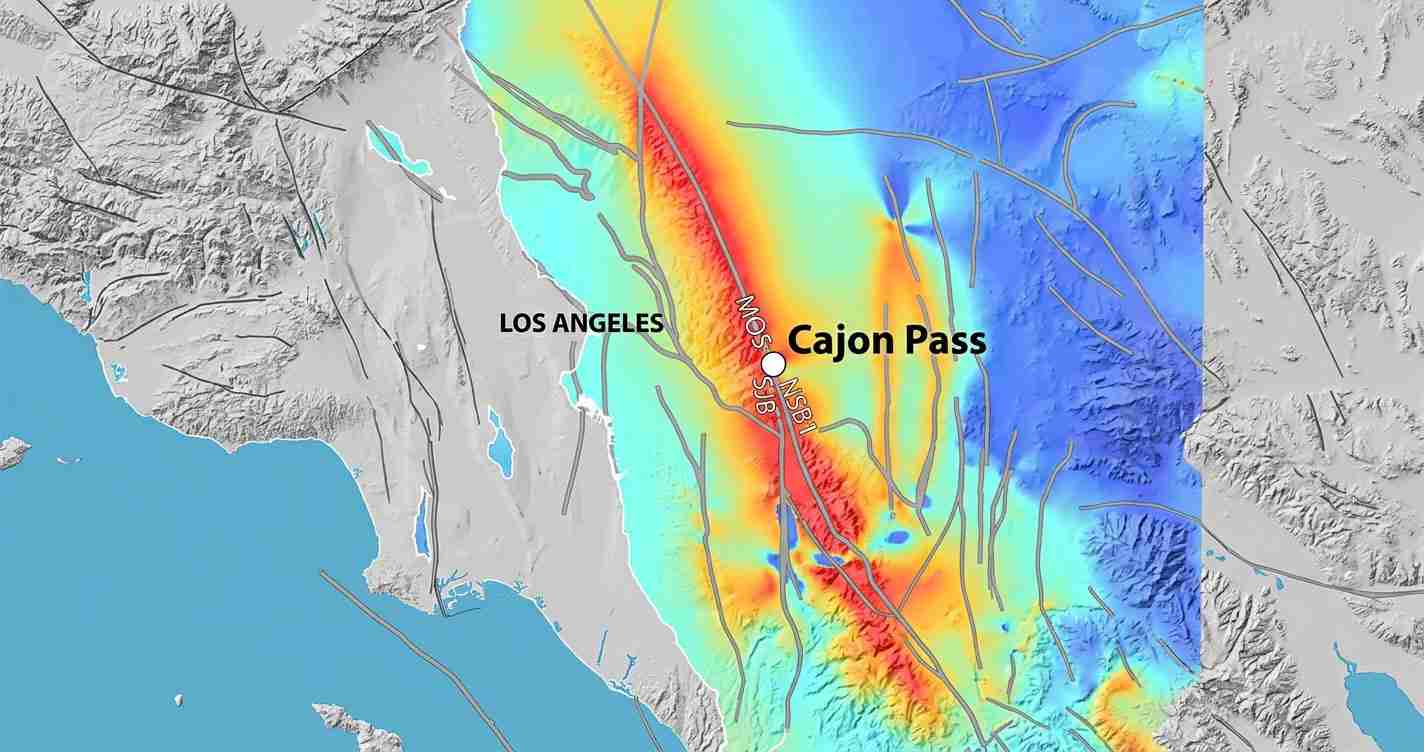
SAN BERNARDINO, Calif., June 24 (Inland Empire News Online) — A University of Hawaiʻi at Mānoa-led study published in the peer-reviewed Journal of Geophysical Research: Solid Earth says tectonic stress along Southern California’s San Andreas and San Jacinto fault systems has reached, and in some places exceeded, the highest levels seen in the past 1,000 years.
The finding centers on a fault corridor that runs through or near the Inland Empire and other populated parts of Southern California. The study says the stressed system could support a large rupture that involves both fault networks, with possible effects on Los Angeles, San Bernardino, Riverside and the Coachella Valley.
Lead author Liliane Burkhard, a research affiliate in UH Mānoa’s Hawaiʻi Institute of Geophysics and Planetology and a scientist at the University of Bern in Switzerland, said the results show stress on multiple fault segments is now at or above the highest values seen in the past millennium.
“Our results show that stress levels on multiple fault segments are now at or above the highest values seen in the past millennium and that the region may be capable of a large through-going rupture involving both fault systems,” Burkhard said in the university’s release.
The study, according to the release, adds to seismic hazard assessments in a corridor that is both densely populated and critical to infrastructure in Southern California. The release said the area has gone more than 160 years since the last major rupture, leaving the system in what the authors described as a critically loaded state.
The paper’s framing is based on a 1,000-year reconstruction of tectonic stress across the fault system. Rather than predicting exactly when an earthquake will happen, the study compares present-day stress to the highest levels found in that long-term record.
According to the study as summarized in the university release and a report on the paper, modeled stress reached 3.6 MPa on the San Jacinto-Bernardino section, a level described as higher than any other point in the 1,000-year simulation. The same summary said stress reached 2.8 MPa on the neighboring Mojave South section of the San Andreas Fault.
Those values matter because the study treats them as signs that several connected fault sections are now close to the upper end of the historical stress range, not just isolated parts of the system. The paper’s authors say that pattern is important for understanding how strain may be building across the broader fault network.
The university release said Cajon Pass could help a joint rupture of the San Andreas and San Jacinto faults occur at the same time. The release said such a rupture could be significantly more damaging than a single-fault event.
Cajon Pass sits in the Inland Empire region and is a key geographic gap between fault segments. In the study’s scenario, that location could allow stress to transfer across the system in a way that links the two faults in one large event.
The release said the consequences could extend across the Inland Empire and beyond. It named Los Angeles, San Bernardino, Riverside and the Coachella Valley as areas that could be affected if both fault systems ruptured together.
The Journal of Geophysical Research: Solid Earth publication gives the work peer-reviewed status, but the brief materials do not include the full methods, confidence intervals or the detailed assumptions behind the model. The university release nonetheless presents the result as a significant update to how scientists assess earthquake hazard in Southern California.
Burkhard said the stress levels and the time since the last major rupture leave the fault system in a critically loaded state. That assessment is based on the study’s reconstruction of fault stress over the past millennium, not on a forecast of a specific earthquake date.
The university release identified the research team as Earth scientists at UH Mānoa. It said the study was published in the Journal of Geophysical Research: Solid Earth and listed Burkhard’s affiliations with both UH Mānoa and the University of Bern.
For the Inland Empire, the study’s main concern is not a single fault line but a linked system that may be able to move together. In the authors’ view, that broader rupture potential is what makes the current stress levels notable for local earthquake planning and hazard analysis.
